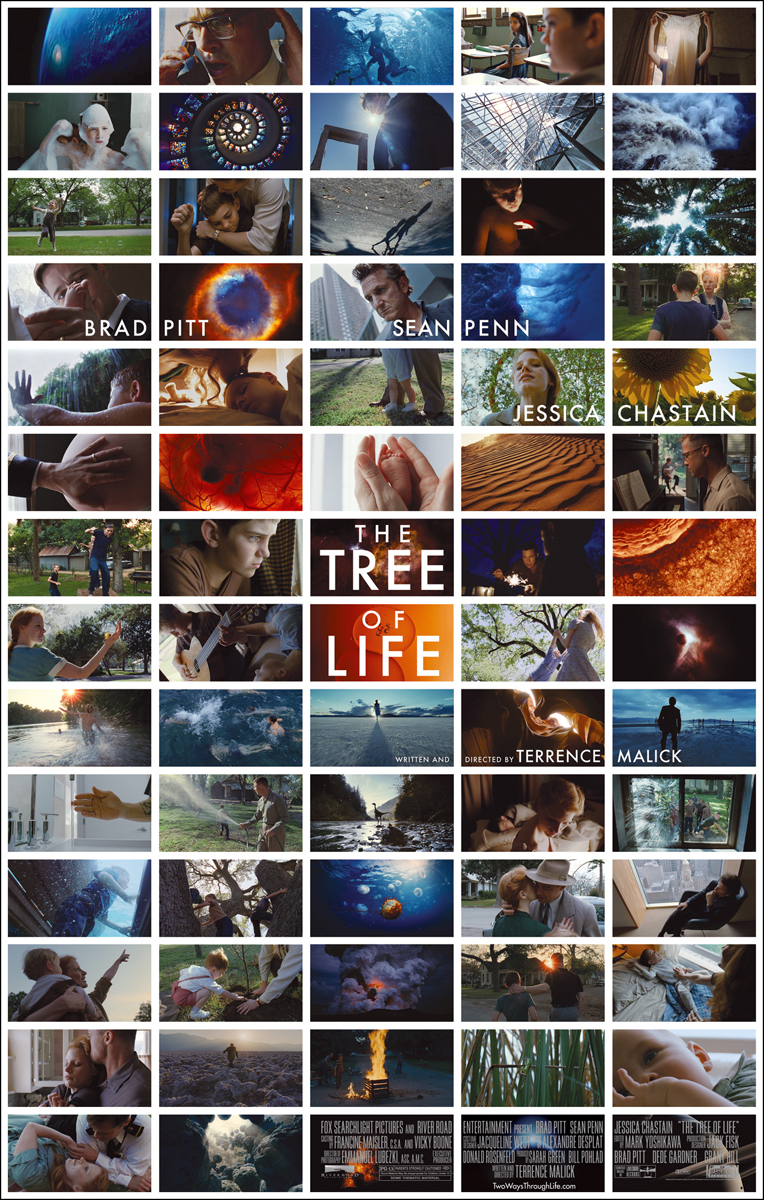
 When I first spotted the poster design for the latest Terrence Malick film, “The Tree of Life”, I was reminded of how powerful the effect can be of doing things differently. Although it may seem like a hackneyed thought in the world of marketing, the simple effect of creating a grid of images to create a movie poster seemed somehow revelatory. What followed for me, was a meandering path of movie poster research too tangential and varied to summarize succinctly, but what became apparent was that in the history of entertainment poster design, little has changed since its inception. From an historical perspective, entertainment poster design really took off in the late nineteenth century, with the perfection of colour lithography and mass printing, creating an outlet to showcase the talents of such artists as Toulouse-Lautrec with his now iconic posters promoting the Moulin Rouge. Since then, entertainment and movie posters have managed to capitalize on every major art movement and leveraged every graphic design star from Saul Bass to Rex Ray. Yet when you look at the art form as a whole, not surprisingly, it’s those unique posters that deviate from the norm that have had the most impact on our collective imagination. Those that make you think a little more, versus those that attempt to depict a scene, character or visual montage to encapsulate the film. So at the risk of stating the obvious, sometimes breaking the mold can often have a great effect. Yet ironically, it can only work when the established norm is entrenched in our visual lexicon. So the lesson becomes recognizing when these have reached a level of visual universality, so that flipping it on its head will have the most impact.
peter g
 idea curators