#4 / The 5 things I learned, but already knew from the Post-Advertising Summit

Mapping the TV Genome

Data is the new sexy 

In the world of marketing, when someone utters the word “data”, let’s be honest, it doesn’t exactly conjure up images of Mad Men’s Madison Avenue; but Bluefin Labs is trying to change all that. Founded by two Ph.D. grads from MIT, Bluefin has applied cognitive science combined with large scale computing to successfully link TV to social media and have developed what they call “Social TV Analytics”.  The algorithms they have created use what is called “language grounding” to attach language to context, enabling their technology to listen to everything that is happening in social media and map it back to the TV stimulus that generated the conversation in the first place.  The data produced from this media analysis mapping is known as the TV Genome – and its media and commercial applications are pretty evident.  Need to know which TV shows are generating the most social engagement by audience segmentation – Bluefin has the answer… and I suspect a lot more. Bluefin is currently partnering with leading global brands, advertising agencies, and TV networks to leverage the “TV Genome” for everything from media planning to uncovering consumer insights. I highly recommend you watch founder Deb Roy’s TED talk on “The Birth of a Word” – fascinating stuff…
Maybe data can be sexy after all.

Final Post: The Hunger Games and Social Media

peter g
#3 / The 5 things I learned, but already knew from the Post-Advertising Summit

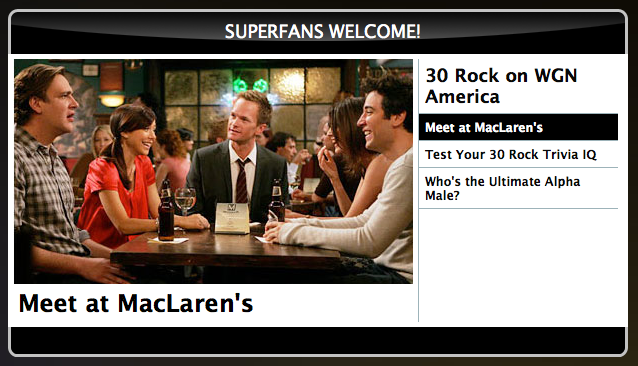
WGN Superfans: "How I Met Your Mother"

Traditional Networks are trying to evolve

If you think most networks are unable to adapt to the new reality of the online world, Josh Richman, VP Marketing at WGN America would beg to differ. The network has been actively cultivating their personal group of social influencers. They have identified brand ambassadors (Superfans) based on members who are signed up to their cable channel, and engaged in content on Facebook leveraged around their syndicated programming. These “Superfans” generate content promoting WGN’s line-up and keep engagement levels up, a unique challenge for WGN since they don’t actually create any of their own TV shows. Whether these activities are bearing fruit is hard to say, since I’m guessing they rely on traditional advertising as a primary revenue stream. But it is surprising to see how many viewers are engaged in content WGN has created around their “borrowed” programming… or maybe 1,093, 541 fans just don’t realize they’re not on the official How I Met Your Mother Facebook page?
Did I say there was something to be learned here? I’ve forgotten…

Tomorrow: Social Media chatter and BlueFin Labs

peter g

#2 / The 5 things I learned, but already knew from the Post-Advertising Summit

Jedi Kittens Strike Back

Jedi Kittens Strike Back

If Wharton is trying to figure out what makes ads go viral…shouldn’t you?

It was an eye opener to learn that business professors and statisticians, at one of the most prestigious business schools in the United States, are trying to distill a formula that guarantees online viral success. Although I have a fundamental problem with trying to define creativity in quantitative terms, the fact that they are even attempting this signals that achieving “viral” status has moved beyond the boardroom table and into the classroom. As educators begin to incorporate this challenge into curricula, “bottling” creativity as a series of basic principles to be instilled in the next generation of marketers is well underway. I won’t get into the tedious details of their research methodology, the controls, the scoring, etc., but for what it’s worth, their findings suggest that there are 4 common denominators that characterize successful viral videos. They must be: creative, surprising, emotional, and of course cute. In the end, are the results really that surprising? In fact, the first 3 characteristics could describe probably all of the great advertising campaigns of the last 25 years. So for a creative person, there isn’t much here that is new. Cute, on the other hand, is another story…Cue the cat video.

Tomorrow: How traditional television networks are leveraging social media

peter g

#1 / The 5 things I learned…but already knew from the Post-Advertising Summit

Post-Advertising Summit

I recently attended the Post Advertising Summit in New York city hosted by Story Worldwide; and as with any conference, you always hope to walk away knowing more than when you traipsed in. I must admit I was a bit disappointed on this front, but I can say that it did expand on a few things I already knew. Here are 5 things I kind of already knew, but found a new spin on…

The notion of authenticity has evolved in the post social media world
Adopting “authenticity” as a cornerstone of your social media strategy has long been a maxim of the online world. The notion that transparency and openness are key to ensuring that consumers trust a brand and are willing to engage in a dialogue, have almost become the hackneyed statements of the marketing community. What’s interesting though, is that this notion of “authenticity” has slowly evolved into an opportunity for content and storytelling. Acknowledging failures and shortcomings (before they’re dredged up by consumers) is the new way to tell stories about how you’re growing as a brand. Or why you’ve decided to change. Humility is in. Check out a few classics:

Domino’s
Chipotle
Patagonia

Tomorrow: What Wharton can teach you about viral videos….

peter g

Blog at WordPress.com.